
Latch Guards and Crash Bars, but Still Getting Broken Into?
It is one of the most frustrating calls we get. The owner has done what they were told. There is a latch protector on the door and a crash bar on the inside. And the building still gets broken into, often through the same door, the same way.
We see this on back doors, service doors and loading areas across Saskatoon and Regina. In most cases the hardware the owner bought is not the problem on its own. The problem is that the door and frame flex, and the exit device is either too cheap for the door or was not installed properly. Put those two together with the most common kind of latch, the beveled Pullman latch, and a pry bar gets through in seconds.
The single biggest upgrade for a door like this is to replace the Pullman latch with a square bolt. This post explains why.
What a latch protector does, and what it doesn’t
A latch protector (also called a latch guard) is a steel plate fixed to the outside of the door over the gap at the latch. Its job is to stop someone sliding a tool into that gap and pushing the latch back. We sell and fit them, and they are worth having. Our latch guards and astragals page covers the types.
What a latch guard does not do is hold the door and frame together. If a bar goes in at the hinge side, the top corner or anywhere else along the edge, and the door bends away from the frame, the latch guard just rides along with the door. Nothing touches the latch. The latch simply runs out of strike.
Why the door gives: the door and frame flex
Commercial doors and frames are not as rigid as they look. A hollow metal door is two thin steel skins over a core. A pressed steel frame is a folded sheet with a hollow behind it. Aluminum storefront frames are lighter still.
When someone puts a pry bar into the gap and leans on it, three things happen at once:
- The door edge bows away from the frame. The middle of the door moves more than the corners, and the latch sits near the middle.
- The frame stop and jamb bend the other way. A frame that was never filled or anchored properly into the wall gives more than you would expect.
- The gap between them opens up. Once it opens wider than the latch reaches into the strike, the latch is out, and the door swings open.
The latch itself may be undamaged afterwards. Owners are often told “the lock worked fine,” which is true and no comfort at all.
Flex gets worse with age. Worn hinges let the door drop, so the gap is already wider than it should be at the latch. Our post on a door that will not close or latch covers sag and frame movement, and the same faults make a door easier to force. Saskatchewan winters add to it: frost heave and building movement shift frames every season.
The other half: a cheap or badly installed exit device
Flex alone does not open a door. It opens a door when the exit device gives it a head start. These are the faults we find most often:
- A light-duty device on a heavy-use door. Budget devices tend to have a shorter latch, a lighter strike and thinner internal parts. Less latch in the strike means less flex is needed to get it out.
- Deadlocking that never engages. The deadlocking part only works if the door closes to the right gap. If the door sits too far off the frame, the latch is not deadlocked at all and can be pushed back.
- Fixed with the wrong fasteners. An exit device on a hollow metal door should be through-bolted, or mounted on reinforcement made for it. Sheet metal screws into a thin door skin pull out the first time the door is forced.
- A strike screwed into an unreinforced frame. The strike is where all the force ends up. If it is held by a couple of short screws into thin sheet steel, it bends or tears out.
- Poor alignment from day one. A latch that only just catches the edge of the strike was installed wrong. It may close fine for years and then fail the first time someone pulls on it.
None of this is visible to the owner. The door has a bar on the inside and a guard on the outside, so it looks secure.
Pullman latch vs square bolt: the difference that matters
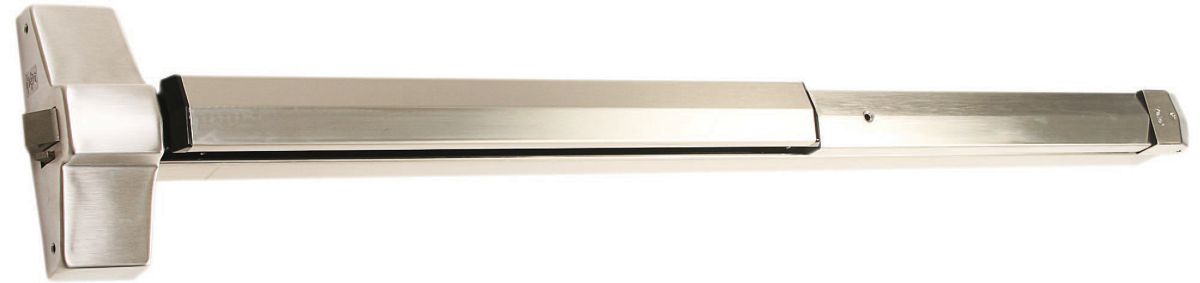
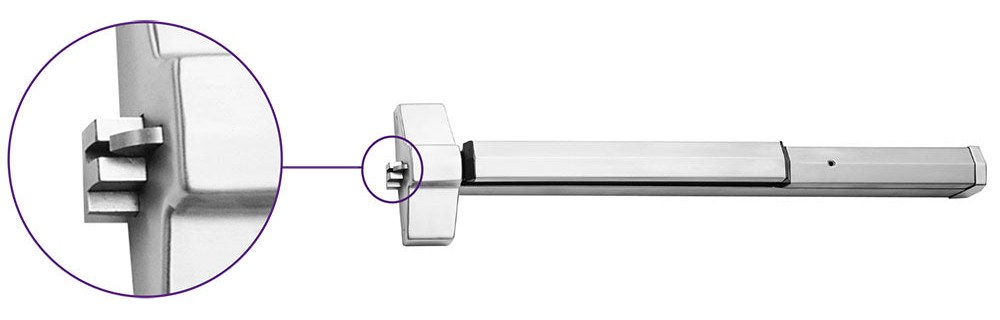
Most crash bars on commercial doors latch with a Pullman latch. On a door that keeps getting forced, that latch is usually the weak point the flex exploits. A square bolt exit device is built to close that gap. Here is how the two compare, using two devices we install often: the Yale 7100 (Pullman latch) and the Accentra (formerly Yale) 7150 SquareBolt.
How a Pullman latch works
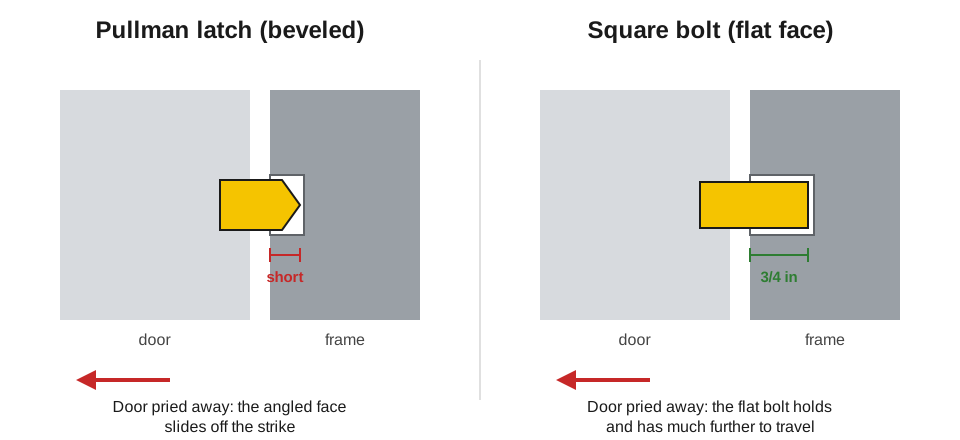
A Pullman latch is a spring-loaded latch with an angled face. As the door swings shut, the angled face hits the strike, the latch is pushed back into the device, and then it springs out into the strike. That is what lets the door latch itself every time, and why it is so widely used.
A good one, like the Yale 7100, adds deadlocking so the latch cannot be pushed straight back once the door is closed. But the latch still only reaches a short way into the strike, and it still has that angled face. When the door is pried and the frame flexes, the angle gives the latch a ramp to ride out on, and the force pushes sideways on the strike and the frame.
How a square bolt works
A square bolt has a flat face, like a deadbolt. The door closes first, and then the bolt slides out into the strike and locks there. Nothing has to push it in on the way past, so it does not need an angle.
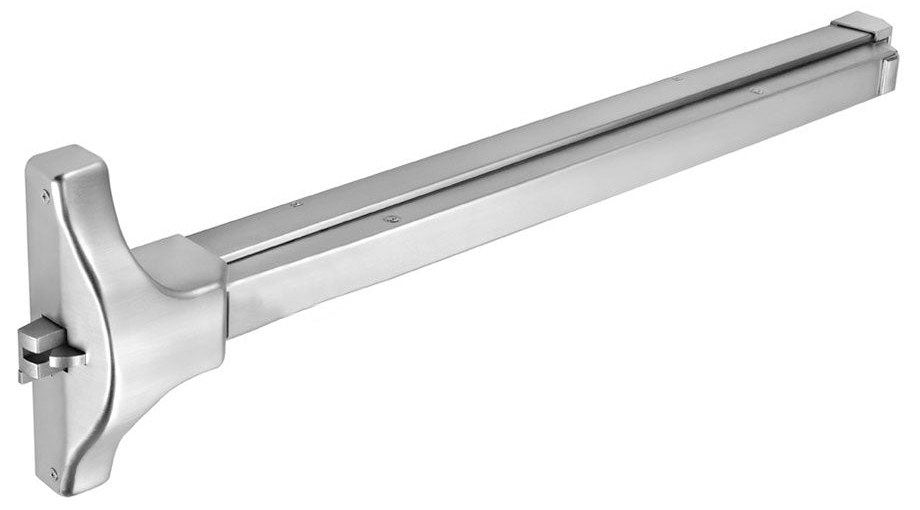
On the 7150 the bolt projects 3/4 inch. With no angled face, pushing or prying on the door does not slide it back into the device. It holds straight into the strike instead of camming against it.
Side by side
| Pullman latch (e.g. Yale 7100) | Square bolt (Accentra/Yale 7150) | |
|---|---|---|
| Latch face | Angled (beveled) | Flat |
| How it latches | Strike pushes it in, it springs out | Bolt slides out after the door closes |
| How far it reaches into the strike | Short | 3/4 inch |
| When the door is pried | Angled face can ride out as the frame flexes | Holds straight; the door must move much further |
| Load on the frame | Pushes sideways on the strike and frame | Holds straight into the strike |
| Exit from inside | One push on the bar | One push on the bar (no change) |
| Best for | Most everyday doors, installed properly | Doors already attacked, rear exits, alleys, service and loading doors |
Can my door take one?
Often it is a straightforward swap. The 7150 can be fitted to doors already prepared for the Yale 7100, which is a common device on commercial doors in Saskatoon and Regina. It is Grade 1 and comes in a fire-rated version (7150F) for fire doors. It needs a door stile at least 4-1/2 inches wide, so it does not suit narrow aluminum storefront doors. Anti-pry brackets are also available for both devices.
A budget-friendly option: the 2150
If cost is the concern, the Accentra (formerly Yale) 2150 puts the square bolt on the 2100 series, Accentra’s economy exit device. It uses a flat pushpad instead of the 7150’s touch bar, is still Grade 1, and comes in a fire-rated version (2150F). Like the 7150 it is made for wide-stile doors. For a back door or service door that keeps getting forced, it gets you the square bolt for less, which is a better use of the money than another latch guard.
A square bolt is not needed on every door. A good deadlocking Pullman latch, properly installed on a solid door and frame, is enough for many openings. The square bolt earns its place on the doors that have already been attacked, and on the hidden ones. Our exit devices and panic bars page lists the other types.
Fix the rest of the opening too
A square bolt works best on a door and frame that are in good shape. Along with the device, we:
- Correct the door. Tighten or replace worn hinges, fix sag, and set the gap so the latch or bolt fully engages. On a door that takes a lot of abuse, a continuous hinge spreads the load along the whole edge.
- Reinforce the frame and strike. Anchor a loose frame, reinforce behind the strike, and use longer fasteners into solid material. Where the frame is damaged, weld and straighten it or replace it. See our hollow metal doors and frames page.
- Mount the device properly. Through-bolt it, or add the correct reinforcement. A Grade 1 device held on with sheet metal screws is not a Grade 1 installation.
What not to do
- Don’t chain, padlock or bar an exit door. It is illegal on a required exit and it is how people die in fires. If the door needs to be stronger, make the hardware stronger.
- Don’t keep adding plates. A second latch guard does nothing for a door that flexes.
- Don’t swap hardware on a fire door without checking its rating. A fire-rated door needs fire-rated hardware, or the rating is gone.
- Don’t assume the lock failed. Look at the door edge, the frame and the strike. Fresh bends and pry marks tell you how the door was opened.
If your exit device is also failing to latch on its own, start with our guide to why a panic bar won’t latch. If you are thinking about adding card or fob control to the same door, read access control basics for small business and our comparison of an electric strike vs a mag lock.
Get the door looked at
Prestige Lock & Door repairs and upgrades commercial doors, frames and exit devices across Saskatchewan, from our branches in Saskatoon and Regina. We look at the whole opening, tell you why it is being forced, and fix the cause instead of adding another plate. See our commercial locksmith and door hardware services.
Call Saskatoon at (306) 880-0307 or Regina at (306) 552-8646, or book a service call.
Frequently asked questions
Why didn't my latch protector stop the break-in?
A latch protector covers the gap between the door and the frame so a tool cannot reach the latch. It does nothing if the door and frame bend apart far enough for the latch to slip off the strike. On most of the break-ins we see, the latch was never touched. The door was pried until it flexed past the latch.
What is the difference between a Pullman latch and a square bolt?
A Pullman latch has an angled face and is pushed in by the strike as the door closes. It reaches a short way into the strike, and the angle gives it a way to slide out when the door is forced. A square bolt has a flat face, slides out into the strike after the door closes and locks there, and on the Accentra (formerly Yale) 7150 it projects 3/4 inch. The door has to move much further before a square bolt lets go.
Can a square bolt device go on my existing door?
Often, yes. The 7150 can be fitted to doors already prepared for the Yale 7100, which is a common device on commercial doors here. It needs a door stile at least 4-1/2 inches wide, so it does not suit narrow aluminum storefront doors, and a fire-rated door needs the fire-rated 7150F version. For a tighter budget, the Accentra/Yale 2150 puts the same kind of square bolt on the economy 2100 series. We check the door before quoting.
Will a stronger exit device stop people getting out in an emergency?
No. A properly specified exit device still opens with one push on the bar from inside, every time. The upgrade only changes how hard the door is to force from outside. What must never happen is chaining, padlocking or blocking an exit door to make up for weak hardware.